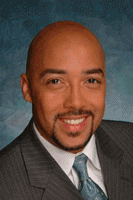
Darryl Taylor
Darryl Taylor is a trailblazing countertenor renowned for his pioneering work in African American art song, spirituals and gospel influenced repertoire, contemporary American song, and music by women composers. He is one of the most extensively recorded classical singers in African American art song and spirituals and a leading advocate for women composers, positioning him as a transformative champion for underrepresented voices in contemporary vocal music.
His landmark recordings include Love Rejoices: Songs of H. Leslie Adams (Albany), Dreamer: A Portrait of Langston Hughes (Naxos American Classics), Fields of Wonder: Songs and Spirituals of Robert Owens (Albany), How Sweet the Sound: A Charm of Spirituals (Albany), Music of Zenobia Powell Perry: Art Songs and Piano Music (Cambria), and the two disc Dear Friends & Gentle Hearts: African American Art Song Essentials, as well as Rosanna Scalfi Marcello: Complete Solo Cantatas on Naxos, the first complete recording of her twelve solo cantatas and a groundbreaking contribution to the rediscovery of this Baroque woman composer. How Sweet the Sound in particular has been noted for its reflective and exultant interpretations of spirituals, with commentators praising the way Taylor’s countertenor sound carries this quintessential African American tradition into the realm of art song. Alongside these composer portraits, he appears on women centered projects such as Love’s Signature: Songs by Juliana Hall (MSR), Radiance in Motion and Rendezvous with music by Deon Nielsen Price (Cambria), and Living in the Body, the Naxos double album of songs by Lori Laitman, helping to bring the work of major women composers directly into the recorded canon. He has premiered major cycles by women composers, including Juliana Hall’s O Mistress Mine, Deon Nielsen Price’s To the Children of War and related cycles, and Persis Vehar’s In the Palace of Time, while serving as an early champion of works by Zenobia Powell Perry, Lori Laitman, Maria Thompson Corley, Margaret Bonds, and Florence Price.
In addition to his classical credits, Taylor has deep roots in both spirituals and gospel. He has sung and recorded as soloist with some of the world’s most esteemed preservers of spirituals, including the Albert McNeil Jubilee Singers, the Moses Hogan Chorale and Singers, the Brazeal Dennard Chorale, and the American Spiritual Ensemble, experiences that grounded his artistry in the sound and practice of ensemble spiritual singing. Within the field of historically informed performance, participation in historically grounded ensembles is essential practice. In the realm of spirituals, singing within choirs formed expressly for that repertory provides the stylistic, vocal, and communal context that later informs concert and recital presentations of this music, in the same way that work with period instrument ensembles and historically informed techniques undergirds serious performance of Baroque and other early music.
In parallel, Taylor’s formative work in gospel arises from direct experience within choirs shaped by legendary gospel figures such as Donald Vails, Thomas Whitfield, and the Rev. James Cleveland, whose approaches to sound, phrasing, harmony, and communal expression inform the gospel inflections that surface in his interpretations of African American sacred repertories in the concert hall.
On stage, Taylor’s career encompasses opera, oratorio, recital, and concert spirituals, with appearances ranging from Weill Recital Hall at Carnegie Hall and the Kennedy Center Millennium Stage to the Hollywood Bowl with the Los Angeles Philharmonic in Porgy and Bess, the Carmel Bach Festival, and performances with Bach Collegium San Diego, Lyra Baroque Orchestra, and international festivals in Europe and Cuba. Signature projects include the touring program Langston Hughes in Song, collaborations with Robert Owens, Deon Nielsen Price, Lori Laitman, Juliana Hall, Adolphus Hailstork, Andre Myers, Richard Thompson, Jacqueline Hairston, and other women and Black composers, and featured roles in Cole Porter’s Aladdin, Handel’s Solomon, and baroque cantatas by Rosanna Scalfi Marcello. His recording of the complete Scalfi Marcello solo cantatas has been recognized in scholarly and critical writing as an important act of recovery that reveals these works as compositions of remarkable quality and restores their composer to visibility within the Baroque repertoire.
As founder and president of the African American Art Song Alliance, Taylor has organized four international conferences on African American art song and established the Willis Patterson Research Award, George Shirley Performance Award, and H. Leslie Adams Robert Owens Composition Prize, building lasting structures that honor and advance underrepresented composers and performers. His leadership has been recognized with honors such as the Trailblazer Award from the National Association of Negro Musicians and a Flora Family Foundation grant, and extends to service with the American Academy of Teachers of Singing, the National Association of Teachers of Singing in advocacy and equity initiatives, the Recording Academy, and the Hampsong Foundation, as well as long term faculty work at the University of California, Irvine, where he has directed Vocal Arts, led UCI Opera, and served as an equity advisor and mentor while shaping curricula and recruitment around principles of inclusion and artistic excellence.
Across these intertwined roles as performer, producer, curator, organizer, and teacher, Taylor’s career offers a sustained model of how a single artist can expand the repertoire, reframe the canon, and transform institutional cultures in service of racial and gender equity in vocal music, with spirituals and gospel influenced repertory standing alongside art song as equal partners in that work.